

Intraocular lens implants (IOLs)
Brief Introduction
A cataract is a condition in which the natural lens in the eye becomes opacified due to aging. Other factors, besides age, can lead to opacification of the lens, such as diabetes, steroid use, trauma, excessive UV exposure, smoking, previous eye inflammation, and others. Symptoms associated with a cataract include blurred vision even with glasses or contact lenses, more frequent changes in glasses or contact lens prescriptions, nighttime glare and halos around lights such as oncoming headlights, need for increased illumination while reading, etc. Cataract surgery involves removing the opacified lens and replacing it with an artificial lens, called an intraocular lens or IOL. With advancing technology, there are now many IOL options. Your surgeon can help you select an IOL that is best suited to your lifestyle and overall eye health.
Brief History of Cataract Surgery
Couching, a technique dating back to the 5th century BC, was one of the first surgical interventions for cataracts. In this technique, a sharp needle was introduced into the eye and used to manually push the cataract into the back of the eye. There were many complications with this method and visual results were poor. Later, other techniques were developed to remove the lens, and the eye was left aphakic (no implant was placed to replace the lens). Those were the days of “coke-bottle glasses.” During World War II, Dr. Harold Ridley observed a Royal Airforce pilot who sustained penetrating trauma with plastic shrapnel to the eye. Despite having a plastic foreign body in the eye, the pilot remained asymptomatic for years without any significant inflammation. This observation prompted the invention of the first IOL, made of polymethylmethacrylate (PMMA), a plastic used in airplanes at that time. In 1949, Dr. Ridley implanted the first IOL. Since that time, many advances have been made in cataract surgical techniques as well as IOL types, decreasing complications and improving outcomes. Today, there are approximately 4 million cataract surgeries with IOL implantation performed every year in the US.
Questions to Consider When Choosing the Right Intraocular Lenses for You
-
Would you like to be less dependent on glasses after cataract surgery?
If so, would you prefer to be less dependent on glasses for distance vision, near vision, mid-range vision, or all distances? (AKA – what would you prefer to see with your naked eye?)
-
Do you have corneal astigmatism that can be corrected with an IOL? (This will be determined after measurements are obtained of your eyes)
- Astigmatism means the front of the eye (cornea) is not perfectly round (like a basketball) but is more elliptical (like a football).
- Astigmatism causes blurring and shadowing/doubling of images.
- Toric IOLs can correct astigmatism.
-
Do you have a history of refractive surgery such as RK, LASIK or PRK?
Intraocular lens calculations are not quite as accurate if you have had previous refractive surgery. Therefore, the light adjustable lens may be a good option to titrate results as closely as possible, because the power can be adjusted after the lens is in your eye.
-
Are you willing to pay out of pocket fees on top of what your insurance covers?
- In the US, insurance companies only cover standard monofocal lenses and monofocal “plus” lenses. They do not cover any premium IOLs including toric lenses, multifocal lenses, and extended depth of focus lenses. If you would like a premium IOL, you will have an out of pocket fee.
- Financing is available through the CareCredit program. See below.
-
Have you ever tried Monovision (one eye set for near and one eye set for distance)?
- Monovision can be done with cataract surgery, in which one eye is set for distance vision and the other is set for near/intermediate vision.
- This option is typically only recommended for patients who have tried monovision previously with contact lenses or previous refractive surgery.
- The advantage is having good vision at distance and near with decreased dependence on glasses. The disadvantage is decreased depth perception as both eyes are never focused on the same focal point.
-
Do you have other ocular issues?
If you have retinal or corneal issues, for example, you are likely not a good multifocal of extended depth of focus lens candidate. Your ophthalmologist will help determine which lenses may not be good options for you.
Learn More About Your Lens Options
Click each lens option below to read more!
-
Standard Monofocal Lenses
This is the most common type of IOL used in cataract surgery. It has one focusing distance, set either for distance, intermediate, or near vision. Glasses are then worn for the other distances. Most people have the lens set for distance and then wear glasses for intermediate and near vision. However, some people choose to set the lens for intermediate or near vision and wear glasses for distance vision. Typically, people who choose this second option are those who have been nearsighted most of their life.
These lenses do not correct for astigmatism and are a good option if you do not have a significant amount of astigmatism or if you are unable or unwilling to pay out of pocket. Insurance companies cover the cost of these lenses.
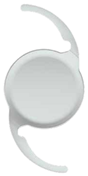
Lens Company Image Material Additional Details DCB00 J&J 
UV blocking acrylic Most common monofocal lens we use AR40E J&J 
Acrylic optic, PMMA haptics 3-piece IOL, typically used in special circumstances ZA9003 J&J 
Acrylic optic, PMMA haptics 3-piece IOL, typically used in special circumstances SY60WF Alcon 
UV and blue light filtering Acrylate/ Methacrylate Copolymer Newer material prevents glistenings (small opacities) which can degrade vision quality over time CC60WF Alcon 
UV absorbing Acrylate/ Methacrylate Copolymer Newer material prevents glistenings (small opacities) which can degrade vision quality over time EE B&L 
UV blocking acrylic Good for patients with low spherical aberration (optical property of the cornea) -
Monofocal “PLUS” Lenses
This lens is a monofocal lens, similar to the ZCB00, but its unique shape is designed to extend the depth of focus. It typically provides good distance vision with reasonably good intermediate vision. Glasses are still typically required for small print at near distances.
These lenses do not correct for astigmatism and are a good option if you do not have a significant amount of astigmatism or if you are unable or unwilling to pay out of pocket. Insurance companies cover the cost of these lenses.
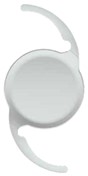
Lens Company Image Material Additional Details DIBOO/Eyhance J&J 
UV blocking acrylic Not ideal for everyone, but we use it often when appropriate -
Toric Lenses
The lenses mentioned above have a specific power to correct spherical error (nearsightedness/farsightedness). As described, monofocal lenses are set for one distance, requiring glasses for the others. EDOF and multifocal lenses, described below, decrease dependence on glasses by correcting spherical error at multiple distances. However, most people don’t simply have spherical error; they also have cylindrical error, called astigmatism. Astigmatism is due to irregularity in the shape of the cornea and causes images to appear blurred or slightly distorted. It can be corrected either with glasses/contacts or with a toric IOL. A small degree of astigmatism won’t have much impact on vision and doesn’t need to be corrected. However, if a larger amount of visually significant astigmatism isn’t corrected with a toric IOL during cataract surgery, then glasses will likely be required for all distances to achieve best vision. Almost all IOL types come in a toric version. Your surgeon will discuss astigmatism with you and advise if you would benefit from a toric IOL.
Insurance companies do NOT cover the cost of astigmatism correction with toric lenses. There is an additional out-of-pocket expense for toric IOLs.
-
Extended Depth of Focus (EDOF) Lenses
These lenses work by creating a single elongated focal point to enhance “range of vision” or “depth of focus.” These lenses typically provide good distance vision, good intermediate vision and functional near vision. Patients may still require glasses correction for small print at near distances or for extended periods of reading. Downsides include possible mild haloing around lights at night and a slight decrease in brightness and contrast, mostly noted in dimmer lighting and at night.
These lenses are available in toric versions (see toric lenses below) and can correct for astigmatism. Insurance companies do NOT cover the cost of these lenses. There is an additional out of pocket expense for these premium IOLs.
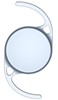
Lens Company Image Material Additional Details DEN00V/ PureSee J&J 
UV blocking acrylic Slight reduction in contrast. Minimal to no halos. DFT/ Vivity Alcon 
UV and blue light filtering Acrylate/ Methacrylate Copolymer Newer material prevents glistenings (small opacities) which can degrade vision quality over time. Minor halos may occur. -
Multifocal Lenses
These lenses consist of multiple zones of lens power that produce multiple focal points. They typically provide good distance, intermediate, and near vision without glasses. The downsides may include nighttime halos and glare due to their diffractive design with rings on the optic. They also reduce contrast sensitivity, making images appear slightly washed out and requiring more light to read. So, there is a trade-off for a more spectacle-free life.
These lenses are available in toric versions (see toric lenses below) and can correct for astigmatism. Insurance companies do NOT cover the cost of these lenses. There is an additional out of pocket expense for these premium IOLs.
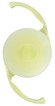
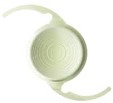
Lens Company Image Material Additional Details DRN00V/ Odyssey J&J 
UV and violet light absorbing acrylic Improved near vision over J&J’s previous trifocal lens, giving better near than PureSee PXCAT0/ PanOptix Pro Alcon 
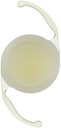
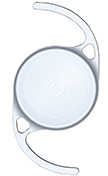
UV and blue light filtering Acrylate/ Methacrylate Copolymer Improved version of the PanOptix, with less contrast loss in dim lighting and reduced halos EN/ enVista Envy B&L 
UV filtering hydrophobic acrylic May have fewer halos than other multifocal lenses -
Light Adjustable Lens
This IOL is the first and only lens that can be customized after cataract surgery. Although pre-operative measurements are typically very good, there is still slight variation in the entire process, especially in patients who have had previous refractive surgery (RK, PRK, LASIK, etc.). With this lens, we now have the ability to titrate refractive results very closely to the desired outcome. 2-4 weeks after cataract surgery, a refraction is performed. That data is then input into a Light Delivery Device, which employs ultraviolet light to change the focus of the lens. It can be used to treat spherical error (nearsightedness/farsightedness) and cylindrical error (astigmatism). There can be up to 3 treatment sessions followed by 1 to 2 lock in sessions.
These lenses have one focusing distance, set either for distance, intermediate, or near vision. Glasses are then worn for the other distances. Most people have the lens set for distance and then wear glasses for intermediate and near vision. However, most people who get this lens have had previous refractive surgery and therefore have some aberration in their cornea which may give them some ability to focus at intermediate and near. Glasses may still be required for small print at near distance.
These lenses are a good option if you have had previous refractive surgery. Insurance companies do NOT cover the cost of these lenses. There is an additional out of pocket expense for these premium IOLs.
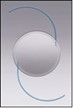
Lens Company Image Material Additional Details LAL RxSight 
UV absorbing Silicone optic with PMMA haptics Patients are required to wear UV protective glasses from the company until all treatments completed.




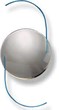
So… which implant is right for you?
Choosing an intraocular lens for your cataract surgery may seem a bit overwhelming. Reviewing the 6 questions above will help you get started. Your ophthalmologist will then discuss options with you and help you make a selection suited for your lifestyle.

As a service to our patients, we are pleased to offer the CareCredit card, the nation’s leading patient payment plan. With CareCredit you can finance 100% of your procedure and there are no upfront costs, no annual fees, and no pre-payment penalties. So, you can begin your refractive or elective procedure today and conveniently pay with low, monthly payments.
CareCredit offers several payment plans so you can find one that work’s best for you. With the popular No Interest Payment Plans* there are no interest charges if you pay your balance in full within the specified time period. Monthly payments can be as low as 3% of your balance. For procedure fees from $1,000 to over $25,000 CareCredit offers 24, 36, 48, and 60 month plan options with low monthly payments available.
CareCredit can be used by the whole family for ongoing treatment without having to reapply. And by using CareCredit for your vision care, you can save your other credit cards for household or unplanned expenses. It only takes a few minutes to apply for CareCredit and you may receive an online decision in seconds! Apply Now or see our staff for more details.